


Excavation services in Peterborough Ontario are what a homeowner needs when the pipe buried under the yard has failed beyond what a liner, a burst, or a cleaning can address. Most pipe problems in residential plumbing are discovered through a camera inspection, and most homeowners hope for a trenchless solution that avoids tearing up the property. In many cases, trenchless methods work.
But when the camera shows a collapsed section, a back-pitched grade, severe joint displacement, or pipe material that cannot support a liner, the only path to a permanent repair is opening the ground and replacing what is broken.
In this article, you will learn what camera findings indicate that excavation is necessary rather than trenchless repair, how Peterborough’s soil and ground conditions affect the scope and cost of the dig, what Ontario law requires before anyone puts a shovel in the ground, what happens during a residential excavation from the first cut to the final compaction, and how proper planning and execution minimize the disruption to the yard, the driveway, and the landscaping.
Here’s what you need to know.
- Most water and sewer line excavation starts with a camera finding something a liner cannot solve
- Peterborough soil and ground conditions change what excavation looks like from one property to the next
- Ontario law requires a locate request before anyone puts a shovel in the ground
- What happens during a residential excavation from the first cut to the last layer of backfill
- The yard, the driveway, and the landscaping recover faster when the excavation is planned correctly
Keep reading to understand what excavation involves, why it is sometimes the only option, and how a properly planned dig produces a result that outlasts the pipe it replaced.
Most water and sewer line excavation starts with a camera finding something a liner cannot solve
Trenchless repair methods, including CIPP lining and pipe bursting, work within the geometry and structural envelope of the existing pipe. When that geometry is compromised beyond what trenchless methods can accommodate, excavation becomes the necessary path. The camera inspection is the diagnostic step that makes this determination.
A collapsed section, a severe belly, or a back-pitched grade cannot be fixed from inside the pipe
A CIPP liner follows the interior contour of the existing pipe. If the pipe has collapsed and the opening is closed or nearly closed, there is no channel for the liner to enter and no structure for it to bond to. A pipe burst requires the bursting head to pass through the existing pipe, which is impossible if the pipe has caved in and the surrounding soil has filled the void.
A severe belly where the pipe sags well below grade creates a permanent low point that holds standing water and waste. A liner can coat the inside of the sag, but it cannot correct the grade. The belly remains, the standing water remains, and the conditions that caused chronic slow drainage continue after the lining is complete.
A back-pitched section where the pipe runs uphill instead of downhill toward the municipal main prevents gravity from moving the wastewater. No trenchless method corrects the grade of the pipe. Excavation is necessary to remove the misaligned section, re-establish the correct slope, and install new pipe at the proper grade.
Clay pipe that has shifted at every joint may not hold a liner or accept a pipe burst
A clay sewer lateral with widespread joint displacement, where the sections have shifted laterally or vertically at multiple points along the run, presents challenges for both lining and bursting. A liner must bond to a relatively continuous interior surface. When the joints are offset by a centimetre or more, the liner bridges the offset but the abrupt change in alignment creates a stress point in the cured material.
Pipe bursting requires the bursting head to follow the general path of the existing pipe. When the joints have shifted significantly, the bursting head may not track smoothly through the offsets, and the new pipe may be pulled off-course by the irregular path of the old one.
A camera inspection that shows joint offsets at most or all connections along the lateral is typically a finding that steers the recommendation toward full excavation and replacement with new PVC or ABS pipe laid at a consistent grade on properly prepared bedding.
Conditions that the camera reveals as excavation-required rather than trenchless-eligible:
- A fully collapsed section where the pipe walls have caved in and the cross-section is closed
- A severe belly with more than 5 to 8 centimetres of sag that holds permanent standing water
- A back-pitched section where the pipe runs uphill against the direction of flow
- Widespread joint offset at multiple locations where the sections have shifted beyond the tolerance for lining or bursting
The camera inspection is what separates a trenchless candidate from a job that requires digging
The camera inspection is not just a diagnostic for finding blockages. It is the decision tool that determines the repair method. Without the camera, the contractor is guessing at the pipe’s condition and may recommend trenchless repair for a pipe that cannot support it, or excavation for a pipe that a liner would have fixed at lower cost.
A trenchless pipe repair quote that is not supported by camera footage is a recommendation without evidence. A camera inspection that documents the pipe material, the joint condition, the grade, the presence or absence of collapses and bellies, and the overall structural integrity gives the homeowner and the contractor a shared factual basis for the repair decision.
The camera footage also serves as documentation for insurance claims, warranty discussions, and future reference. It is the record that justifies the scope of the work and confirms that the chosen method matched the actual condition of the pipe.
Peterborough soil and ground conditions change what excavation looks like from one property to the next
Excavation in Peterborough is not a uniform process. The soil composition, the water table, the presence of bedrock, and the frost line depth all vary across the city and directly affect the difficulty, the duration, and the cost of the dig.
Clay-heavy soil holds water and becomes unstable in an open trench during wet weather
Much of Peterborough’s residential land sits on soil with a high clay content. Clay soil is dense and cohesive when dry, but it absorbs water readily and becomes plastic and unstable when saturated. An open trench in clay soil during or after heavy rain can slump, cave, or collapse if the walls are not properly supported.
This characteristic affects the excavation in two ways. First, the trench may require shoring, trench boxes, or sloped walls to maintain stability while the crew works below grade. Second, the excavation schedule is weather-dependent. A project that begins during a dry period and encounters several days of rain may need to pause until conditions allow safe work.
For sewer and water line excavation in Peterborough’s clay-dominant areas, the contractor plans for soil instability by staging the trench in sections, having dewatering equipment on site, and monitoring the trench walls throughout the work.
Shallow limestone bedrock in parts of the city requires equipment that standard trenching does not
Some areas of Peterborough, particularly on the east side and in the higher elevations approaching the Canadian Shield, have shallow limestone bedrock that can be encountered at depths of one to two metres. Standard excavation equipment can cut through soil but cannot break through solid rock without specialized attachments or methods.
When the pipe route crosses or sits within bedrock, the excavation requires a hydraulic breaker, a rock saw, or in some cases a rock trencher to cut through the stone. This equipment is heavier, louder, and slower than standard trenching equipment, and it adds time and cost to the project.
A pre-excavation site assessment that reviews the geological conditions and the depth to bedrock helps the contractor anticipate the equipment needs and provide an accurate estimate before the work begins. Discovering bedrock after the trench is open and the standard equipment cannot proceed creates delays that affect the project timeline and the homeowner’s patience.
- Clay soil requires trench stabilization measures such as shoring or benching to prevent wall collapse during the dig
- Saturated clay soil is significantly more difficult to excavate and backfill than dry soil, which makes scheduling around weather conditions important
- Shallow bedrock requires hydraulic breakers or rock-cutting attachments that add equipment cost and slow the excavation rate
- The depth to bedrock determines whether the pipe can be laid at the required grade without rock removal, which is one of the first factors the contractor evaluates
The frost line in this area sets the minimum depth for any water or sewer line, and that depth adds cost
The Ontario Building Code requires water lines to be buried below the frost depth to prevent freezing. In the Peterborough area, the design frost depth is approximately 1.2 to 1.5 metres, and local practice often calls for deeper burial to provide a safety margin.
Sewer lines must also be buried below the frost depth or be protected from freezing by insulation. A sewer lateral that is replaced during excavation is installed at or below the minimum depth, which means the trench must be at least 1.5 metres deep and often deeper to maintain the required slope from the house to the municipal connection.
The deeper the trench, the more soil must be removed, the more time the crew spends below grade, and the more backfill material is required to close the trench. Depth is one of the primary cost drivers in a residential excavation, and it is a non-negotiable requirement set by code rather than contractor preference.
Ontario law requires a locate request before anyone puts a shovel in the ground
Before any excavation begins on a Peterborough property, the contractor must complete the legal process that identifies and marks the location of all underground utilities. This is not a recommendation. It is a legal requirement under Ontario law.
Ontario One Call marks gas, hydro, telecom, and municipal water before underground utility excavation can begin
The Ontario Underground Infrastructure Notification System Act requires anyone planning to dig to submit a locate request through Ontario One Call at least five business days before the excavation begins. The utility owners then send locate technicians to the property to mark the approximate location of their buried infrastructure with colour-coded paint or flags.
Gas lines, electrical cables, telecommunications lines, and municipal water mains are all marked during this process. The marks show the approximate horizontal position of each utility so the excavation crew can plan the trench route and dig safely around them.
The locate process is free to the property owner, and the contractor is responsible for initiating it. Digging without a locate is a violation of Ontario law that can result in fines, and any damage to an unmarked utility that was not located because the request was not submitted creates legal and financial liability for the party who dug.
Hitting an unmarked line during sewer excavation creates a safety emergency and a liability problem
A natural gas line struck during excavation can release gas that creates an explosion or fire risk. A hydro cable struck during digging can electrocute the operator. A municipal water main damaged during trenching floods the excavation and the surrounding area. Each of these scenarios is a safety emergency that stops the project and introduces costs and consequences far beyond the original scope.
Even with proper locates completed, the marks are approximate. The contractor hand-digs within the tolerance zone around each marked utility to confirm the exact position before bringing the machine in. This careful approach adds time but eliminates the risk of contacting a utility that is a few centimetres off its marked position.
A professional excavation contractor builds the locate request, the waiting period, and the hand-digging protocol into the project schedule from the beginning. None of these steps can be skipped or shortened without creating risk.
A building permit from the city is required for water line excavation and sewer replacement in Peterborough
The City of Peterborough requires building permits for plumbing work that involves replacing a sewer lateral or a water service line. The permit ensures that the work is performed to Ontario Building Code standards and that the pipe materials, grades, and connections meet the requirements.
The permit application includes the scope of the work, the location, and the contractor information. An inspection by the city’s building department is required before the trench is backfilled to verify that the pipe is installed at the correct grade, that the connections are sound, and that the materials are code-compliant.
Q: Who obtains the building permit, the homeowner or the contractor?
The contractor typically obtains the permit as part of the project scope. The permit is issued based on the contractor’s submission, and the contractor coordinates the inspection.
Q: What happens if the trench is backfilled before the inspection?
The inspector must view the pipe installation before the trench is closed. If the trench is backfilled prematurely, the inspector may require it to be reopened, which adds cost and delay.
Q: Does the permit cover the surface restoration as well?
The permit covers the plumbing work. Surface restoration, including driveway patching, lawn grading, and landscaping, is typically part of the contractor’s scope but is not a code inspection item.
Q: How long does the permit and inspection process add to the project timeline?
The permit application takes a few business days to process. The inspection is scheduled when the pipe is installed and ready for review, typically the same day or the next business day. The total addition to the timeline is usually less than a week.
What happens during a residential excavation from the first cut to the last layer of backfill
A residential excavation follows a defined sequence: trench planning, digging, pipe removal, new pipe installation, connection testing, backfill, and compaction. Each step affects the quality and longevity of the finished repair.
The trench depth, width, and shoring depend on the pipe location and what the soil is doing
The trench is laid out based on the pipe route identified by the camera inspection and the utility locates. The width is determined by the pipe diameter plus the working space needed for the crew to access, align, and connect the pipe sections. The depth is determined by the frost line requirement and the grade needed to maintain proper slope from the house to the municipal connection.
In stable soil, the trench walls may be self-supporting at shallow depths. In clay or saturated soil, and at depths exceeding 1.2 metres, the Ontario Occupational Health and Safety Act requires trench protection, which may include sloping the trench walls, installing shoring panels, or using a trench box to protect the crew from cave-in.
The excavator operator cuts the trench to the required dimensions, and the crew hand-finishes the bottom to create a smooth, consistent bed for the new pipe. A pipe laid on an uneven trench bottom will develop stress points at the high spots and bellies at the low spots, which recreates the conditions that caused the original failure.
The old pipe comes out, the new PVC or ABS goes in at the correct grade, and connections are tested
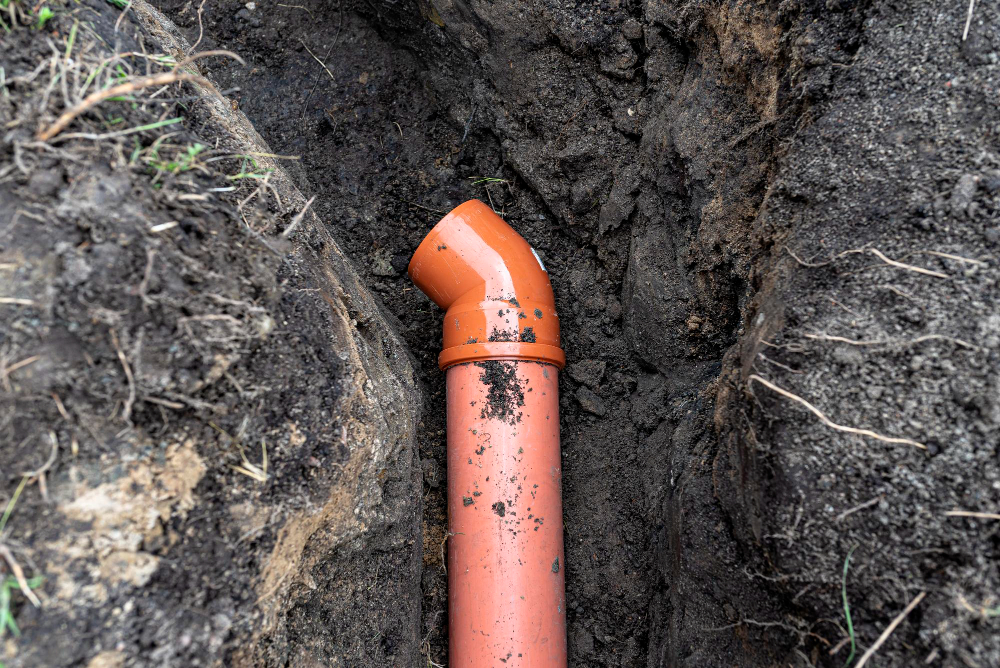
Once the trench is open and the old pipe is exposed, the crew removes the failed pipe sections and prepares the trench bed for the new installation. The bedding material, typically clean granular stone or sand, is placed at the bottom of the trench to provide a stable, even surface for the new pipe.
New PVC or ABS sewer pipe is laid on the bedding at the grade specified by the design, which provides the slope needed for gravity to move wastewater from the house to the municipal main. Each joint is cemented or sealed according to the pipe manufacturer’s specifications, and the connections at the house and the street are made to the existing system.
After the pipe is installed, the connections are tested. A water test or an air pressure test verifies that the joints are sealed and that no leaks exist before the trench is backfilled. The plumbing inspector verifies the installation before the trench is closed.
Backfill and compaction are the part most homeowners do not think about, and the part that causes problems when done poorly
Backfilling the trench is not simply pushing the excavated soil back into the hole. The material must be placed in lifts, which are layers of consistent depth, and each lift must be compacted before the next one is placed. This process prevents the trench from settling unevenly after the surface is restored.
Poor compaction leaves voids in the backfill that collapse over time as rain, freeze-thaw cycles, and the weight of the surface material compress the loose soil. The result is a visible depression along the trench route that may appear weeks or months after the project is finished.
- Backfill is placed in lifts of approximately 20 to 30 centimetres and compacted mechanically with a plate compactor or a jumping jack
- The material immediately surrounding the pipe, called the haunching zone, is placed by hand to avoid dislodging or stressing the new pipe
- Granular backfill is used around and above the pipe to provide drainage and reduce the load on the pipe crown
- Native soil may be used for the upper portion of the fill if it is free of large rocks, frozen chunks, and organic debris that would prevent proper compaction
The yard, the driveway, and the landscaping recover faster when the excavation is planned correctly
The surface disruption from an excavation is the part of the project the homeowner sees and lives with after the plumbing work is complete. A well-planned excavation minimizes the footprint, protects the surrounding landscape, and includes the restoration work needed to return the property to a finished condition.
A narrow trench with proper staging keeps the disruption to one corridor instead of the whole yard
An excavation that is planned with a defined trench route, a designated staging area for the excavated soil, and a path for equipment access contains the disruption to a single corridor rather than spreading it across the property.
The excavator enters the site through a planned access point, works along the trench route, and deposits the soil in a designated area that does not compact or damage additional lawn space. Material deliveries, including pipe, stone, and bedding, are staged in one location rather than scattered across the yard.
A contractor experienced with residential excavation services in Peterborough plans the site layout before the machine arrives and communicates the plan to the homeowner so expectations are clear about which areas will be affected and which will not.
Concrete and asphalt cuts are patched as part of the job but settling over the trench can show up months later
When the trench route crosses a driveway, a sidewalk, or a patio, the concrete or asphalt is cut, removed, and patched after the backfill is complete. The patch is made to match the surrounding surface as closely as possible, but a fresh concrete or asphalt patch over a trench may settle slightly as the backfill beneath it compresses over the following months.
This settling is normal and expected. Most excavation contractors inform the homeowner that minor settling may occur and that a top-up or a second surface pass may be needed the following season. Some contracts include a settlement warranty or a follow-up visit to address any visible depression that develops after the initial compaction has had time to stabilize.
The homeowner should expect the patched area to look slightly different from the surrounding surface immediately after the work is complete. The colour, texture, and elevation may differ from the original. Over time, weathering and use bring the patched area closer to the appearance of the surrounding surface.
Trenching services that include grading, topsoil, and seeding leave the property ready to recover by fall
A complete excavation project includes not just the pipe work but also the surface restoration needed to return the yard to a condition where it can recover naturally. Grading the trench route to match the surrounding grade, spreading topsoil over the disturbed area, and seeding with grass seed appropriate for the season give the lawn a head start on recovery.
A project completed in spring or early summer has the full growing season for the grass to establish. A project completed in fall can be seeded with a fall blend that germinates before winter and fills in the following spring. A project completed in winter may require a temporary surface cover until spring conditions allow grading and seeding.
- Final grading along the trench should match the surrounding lawn elevation to prevent pooling or drainage toward the foundation
- A minimum of 5 to 8 centimetres of topsoil over the compacted backfill provides the growing medium the new grass needs to establish
- Grass seed should be applied at the recommended rate for the species and covered with a light layer of straw mulch or erosion blanket to retain moisture and prevent washout
- The homeowner should water the seeded area regularly for the first four to six weeks after seeding to support germination and root development
Conclusion
Excavation services in Peterborough Ontario are the answer when the pipe underground has deteriorated beyond what trenchless methods can address. A collapsed section, a severe belly, a back-pitched grade, or widespread joint displacement all require opening the ground, removing the failed pipe, and installing new pipe at the correct depth and slope on properly prepared bedding.
The process involves more steps than most homeowners expect. The camera inspection determines whether excavation is necessary. The locate request identifies every utility in the ground. The building permit authorizes the work and triggers the inspection. The trench is cut, shored, and prepared. The pipe is installed, tested, and inspected. The backfill is placed in compacted lifts. And the surface is restored with grading, topsoil, and seeding so the property can recover.
If your Peterborough home has a sewer or water line that a camera inspection has identified as too damaged for trenchless repair, or if you are dealing with a backup or a water line failure that requires underground access, contact Cardinal Home Services to schedule an evaluation and find out what the excavation involves for your property.